Dough ball rounder machines: do you need one?
A rounder won't make better dough than a skilled pair of hands. What it does is make every ball the same, faster, without tying up a person. Here's when that's worth the money, and how the Moon 300 and Moon 1000 differ.
Who’s behind this: the team at TheLoveOfDough, the eBay store that sells these Sunmix machines. Links to eBay go to our own listings.
Short answer: if someone on your team rounds dough for half an hour or more every day, or your dough balls vary from shift to shift, a rounder usually pays for itself. Below that, round by hand. Choose the Moon 300 for pizza balls up to 350 g (12 oz). Choose the Moon 1000 if you also make bigger pieces, up to 850 g (30 oz), such as large New York-style pies or bread.
What a dough ball rounder does
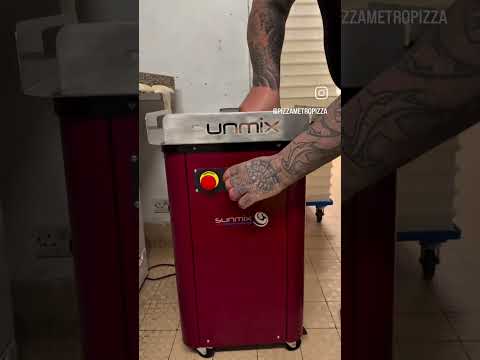
A rounder takes a piece of dough you've already cut and weighed and turns it into a smooth, tight ball. You drop the piece in; the machine rolls and tucks it against a shaped surface until it comes out round, with the skin pulled taut over the top. That's the same thing you do when you round by hand: build surface tension so the ball holds its shape while it proofs.
What it doesn't do is portion. You still divide the dough first. The rounder takes over the part that's repetitive, tiring and easy to do inconsistently.
 0:41
Why consistent dough balls matter
- Even proofing. Balls rounded with the same tension rise the same way, so they're ready at the same time.
- Easier stretching. A well-rounded ball opens into an even circle; a slack or lopsided one tears or goes oval.
- Predictable bakes. Same weight and same shape mean the same bake time and the same crust.
- Food cost. When every ball is right, you aren't throwing out misshapen ones or quietly over-portioning.
Hand rounding vs. a machine
Good hand rounding is a skill. Your best person can do it quickly and beautifully, but it takes training, and results shift with whoever is on shift, how tired they are and how busy the night is. A rounder makes a new hire's dough balls look like your veteran's, and frees that veteran to stretch, top and bake.
A simple way to decide: time how long rounding takes on a normal day, and multiply by what you pay for that time. As an example, 45 minutes a day at $18 an hour is about $350 a month, more than $4,000 a year, before you count the cost of inconsistent balls. If your number is anywhere near that, a rounder is worth a serious look.
Moon 300 vs. Moon 1000
Sunmix's Moon rounders come in two sizes. They share the same body, motor and power needs; the difference is the size of dough piece each one handles.
| Moon 300 | Moon 1000 | |
|---|---|---|
| Dough ball size | 30–350 g (1–12 oz) | 30–850 g (1–30 oz) |
| Good for | Neapolitan and most pizza balls, rolls, buns | All of that, plus large pies, loaves and focaccia pieces |
| Power | 110V single phase, 7 A | 110V single phase, 7 A |
| Motor and speeds | 370 W, 4 speeds | 370 W, 4 speeds |
| Size | 17.7 × 23.2 × 31.5 in | 17.7 × 23.2 × 31.5 in |
| Build | Non-stick auger, stainless steel upper tray, parts come apart for cleaning, wheels with brakes | |
 0:53
 0:18
Which one should you get?
Check your heaviest dough ball. Most Neapolitan-style pizzerias work with balls around 250–280 g, comfortably inside the Moon 300's range. But a 14 inch New York-style pie often uses around 400 g of dough, and 16–18 inch pies more than that. Those are past the Moon 300's 350 g limit, so a New York-style shop, or anyone who also rounds bread, should get the Moon 1000.
Where it fits in your workflow
- Mix and bulk-ferment your dough as usual.
- Divide it into pieces and weigh them.
- Drop each piece into the rounder and catch the ball as it comes out.
- Tray the balls and proof them as normal.
Both Moons run on a regular 110V outlet, so there's no electrical work. They sit on wheels with brakes: roll it to the bench for service, lock it in place, and roll it away for cleaning.
Bottom line
Buy a rounder for consistency and labor, not to fix a dough problem. If your team spends real time rounding every day, it pays back quickly. Pick the Moon 300 for pizza balls up to 350 g and the Moon 1000 for anything bigger. Not sure which one fits your dough? Message us through our eBay store with your ball weights and daily volume.
Still choosing a mixer? Start with what size spiral mixer you need.
Questions people ask
Does a dough rounder also divide the dough?
Not the Moon. It rounds; it doesn't portion. You cut and weigh each piece first, by hand or with a divider, then the rounder turns each piece into a smooth, tight ball.
What size dough balls can the Sunmix Moon 300 make?
From 30 to 350 g (about 1 to 12 oz). For bigger pieces, up to 850 g (about 30 oz), you need the Moon 1000.
Does a dough ball rounder need 220V?
Not these. Both the Moon 300 and the Moon 1000 run on 110V single phase and draw 7 amps, so they plug into a regular outlet.
Is a dough rounder worth it for a small pizzeria?
It depends on how long rounding takes you. If someone spends half an hour or more a day rounding dough balls, or your balls vary a lot from shift to shift, a rounder usually earns its keep. If you round a couple of dozen balls a day, your hands are fine.